What Happens in the Brain When We Journey and Why the Drum Is the Doorway
People often imagine shamanic journeying as something mystical and unknowable. a gift you either have or you don't. The truth is more grounded, and in some ways more remarkable: journeying corresponds to a specific, measurable state of the brain. Understanding that state demystifies the practice and reveals why the work is so effective.
This is a closer look at the brainwave states involved in shamanic consciousness: what they are, what happens in each, and why the shamanic drum is one of the most direct and gentle ways to reach the state where deep healing becomes possible.
We Perceive Reality Differently in Different Brainwave States
Scientists measure brainwaves as a continuum of frequency, classified according to the mental states associated with different ranges. There are five recognized states. The more active the frequency, the more energy the brain requires to maintain it — which is why high-frequency states, held for too long, lead to stress and depletion.
Changes in brainwave state correspond to changes in nervous system function. In adults, normal waking frequency sits at 8 Hz and higher. In children, it's often 7 Hz or lower, which means that children live naturally closer to the dreaming mind. The crucial point is this: the aspects of reality we are consciously aware of are determined by our brainwave state. We quite literally perceive reality differently depending on how our brainwaves are pulsing.
The Five Brainwave States
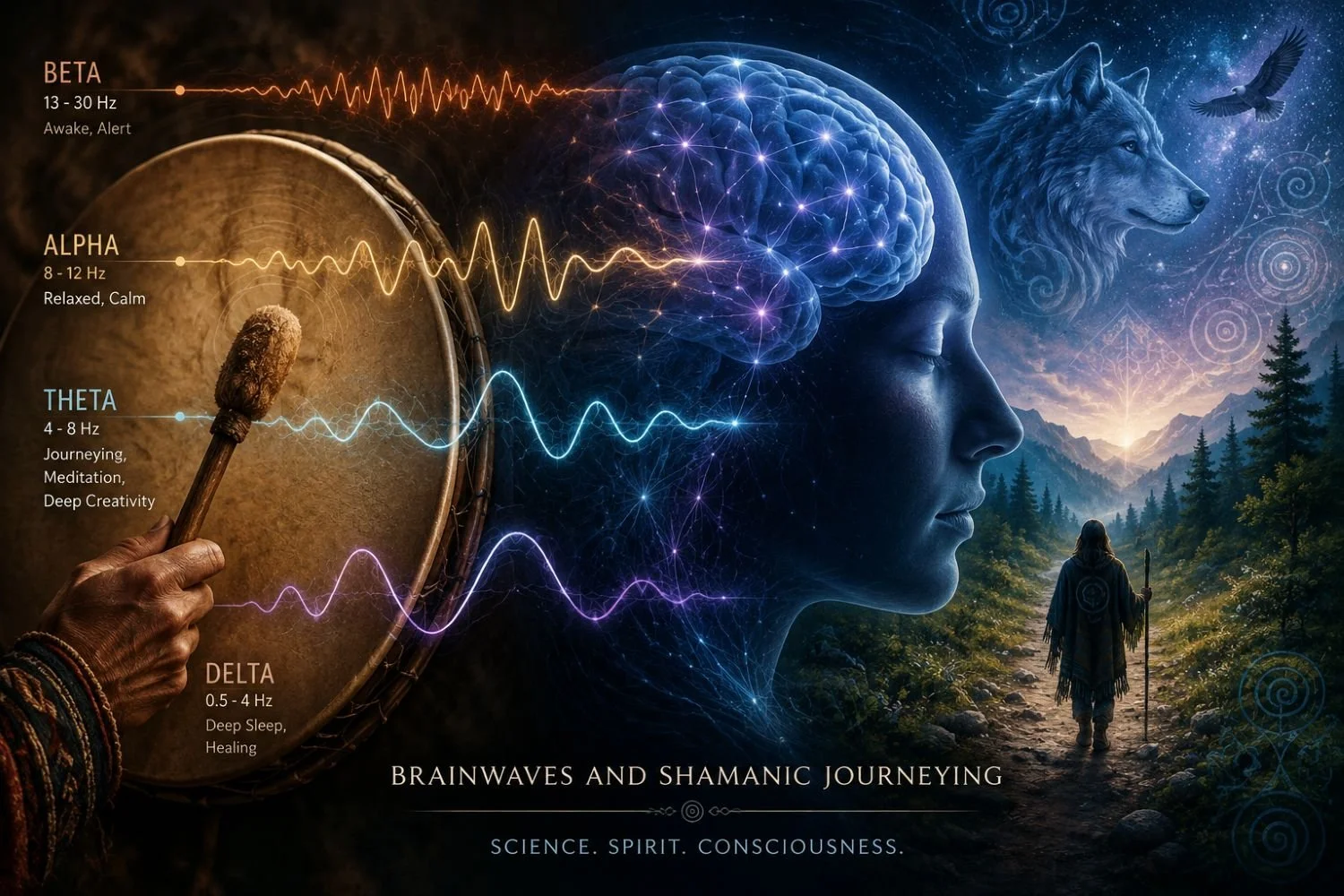
Delta — Deep Sleep 0.5–4 Hz
In Delta, the brain and nervous system rest and recover. We recoup our energy and the nervous system regenerates: anabolic hormones repair tissue and stabilize energy levels, new neurons grow, and new neural connections form. This is why, if you fall asleep during or immediately after a deeply healing journey, it's usually a good sign: your nervous system is recovering from a deeply held trauma, and your brain is laying down new neural pathways to help you integrate the healing.
Theta — Shamanic Journeying, the Spirit Mind 4–8 Hz
Theta is a deeply relaxed, creative, meditative state, often inwardly focused — and it is where both dreaming and shamanic journeying occur. In Theta, we embody our innate capacity for healing and self-healing. Creativity opens, and novel solutions to old problems surface.
Theta is induced by rhythmic movement and repetitive, rhythmic sound — exactly what the shamanic drum provides. The body must be relaxed to enter it, which is why centering practices like Cultivating the Energy Body, meditation or an unhurried walk in nature are so synergistic with journeying; they prepare the ground.
Alpha — Calm, Centered Awareness 8–12 Hz
Alpha is associated with relaxation, reflection, and learning. It's where metacognition happens — seeing the big picture, placing events in context, thinking strategically, making accurate assessments. The body is calm in Alpha.
For the journeyer, Alpha is the bridge between the physical and spirit worlds. When we begin a journey, we first relax into Alpha, then transition down into Theta. When we return and take time to journal our experiences, we move back up from Theta into Alpha — where we can recapitulate what happened in the Dreamtime, assimilate what we learned, and integrate the healing. This is why journaling after a journey isn't an afterthought; it's part of the mechanism.
Beta — Analytical Thinking, the Logic Mind 12–40 Hz
Beta is narrowly focused and often anxiety-dominant. A balanced amount lets us concentrate on individual tasks and solve detailed problems. But Beta is expensive — it demands substantial mental and physical energy to sustain. Too much Beta brings anxiety, stress, an inability to relax, and the fight-flight-fawn-freeze responses of a dysregulated nervous system. Too little brings its own troubles: daydreaming, low mood, poor cognition.
Most of modern life is lived in Beta. Part of what shamanic practice offers is a reliable, trainable way out of it.
Gamma — Peak Performance 40–100 Hz
Gamma is a brief burst of heightened awareness — it can't be sustained for long. True peak performance, the experience of being "in the zone," isn't pure Gamma; it's a combination, resting primarily in Theta and Alpha with small bursts of Gamma interspersed. Consciously training yourself to move in and out of shamanic consciousness cultivates exactly this blend — which is why the practice tends to spill over into sharper insight, more effective action, and better problem-solving in ordinary life.
Why the Drum, and Not Something Else
Shamans and apprentices across cultures and ages have induced shamanic consciousness through many methods: drumming and other rhythmic instruments, fasting, the sweat lodge, entheogenic preparations, meditation, sleep deprirvation and combinations of these. They can all work. But they are not equal in their cost to the body.
To navigate the spirit world effectively over a lifetime, we need to enter shamanic consciousness at will and return at will — as easily as possible, with as little strain on the physical body as possible. Of all the methods, drumming and meditation are the least taxing. Between those two, I prefer drumming and rhythmic trance, for a simple reason: the steady beat blocks out distractions from both the outer world's demands on us and our inner world's wandering mind. Drumming also actively energizes the trance and as you learn to drum for yourself while you journey, the changing moods of the drum and the journey entertwine in a beautiful dance.
What This Means for Your Practice
None of this is required knowledge to journey — people have journeyed beautifully for fifty thousand years without a single Hz reading. But understanding the underlying mechanism does two things. It reassures the skeptical, analytical mind that this is real and grounded, not fantasy. And it explains why the small, repeatable practices we teach are the most efficient path into the precise brain state where healing, creativity, and genuine guidance become available to you.
Shamanic Spirit Medicine teaches a reliable, drug-free, repeatable way to reach the part of your own consciousness where real change happens.
Common Questions
What is actually happening in the brain during a shamanic journey — and why does shamanic healing work when other approaches haven't?